The Work
Lower household pressure. Create useful work. Build community ownership.
Seven Years of Change connects work already happening to needs already present, then helps communities own more of the service, the jobs, and the value created.
The three starting pillars are Nutrition, Housing, and Transportation. Energy, manufacturing, repair, and Green technical work run through all three. Water is in development. Healing has its own pathway.
One need. One existing ability. One safe and lawful action. Record what happened. Keep what helps. Correct or stop what does not.
The work is not to invent a new community. It is to connect what is already there.
Every engine begins with a reason to care.
Who do you love? What do they need? What can you do? Who else can help?
Take the first step.
Then take another.
Seven Years of Change does not ask people to prove how much they care. It gives caring somewhere to go.
What might that look like when a young person simply wants to help the people she loves? Read: What If Her Dream Is to Help the People She Loves?
The engine below is how that care can become useful action, learning, paid work, ownership, and knowledge the next person can use.
How the Engine Moves
Notice → Map → Connect → Act → Record → Repeat or Correct → Earn → Own → Teach.
The Community Survey maps needs, abilities, relationships, places, tools, vehicles, customers, money already moving, practical barriers, environmental conditions, and voices that may be missing.
One safe action tests the first connection. What helps is repeated. What harms, fails, cannot be supported, or cannot be done safely and lawfully is corrected or stopped.
When useful work and real demand continue, more capabilities connect. The work may become paid work, a shared service, a cooperative, or another community-owned asset. What people learn returns to the network so the next person does not begin from zero.
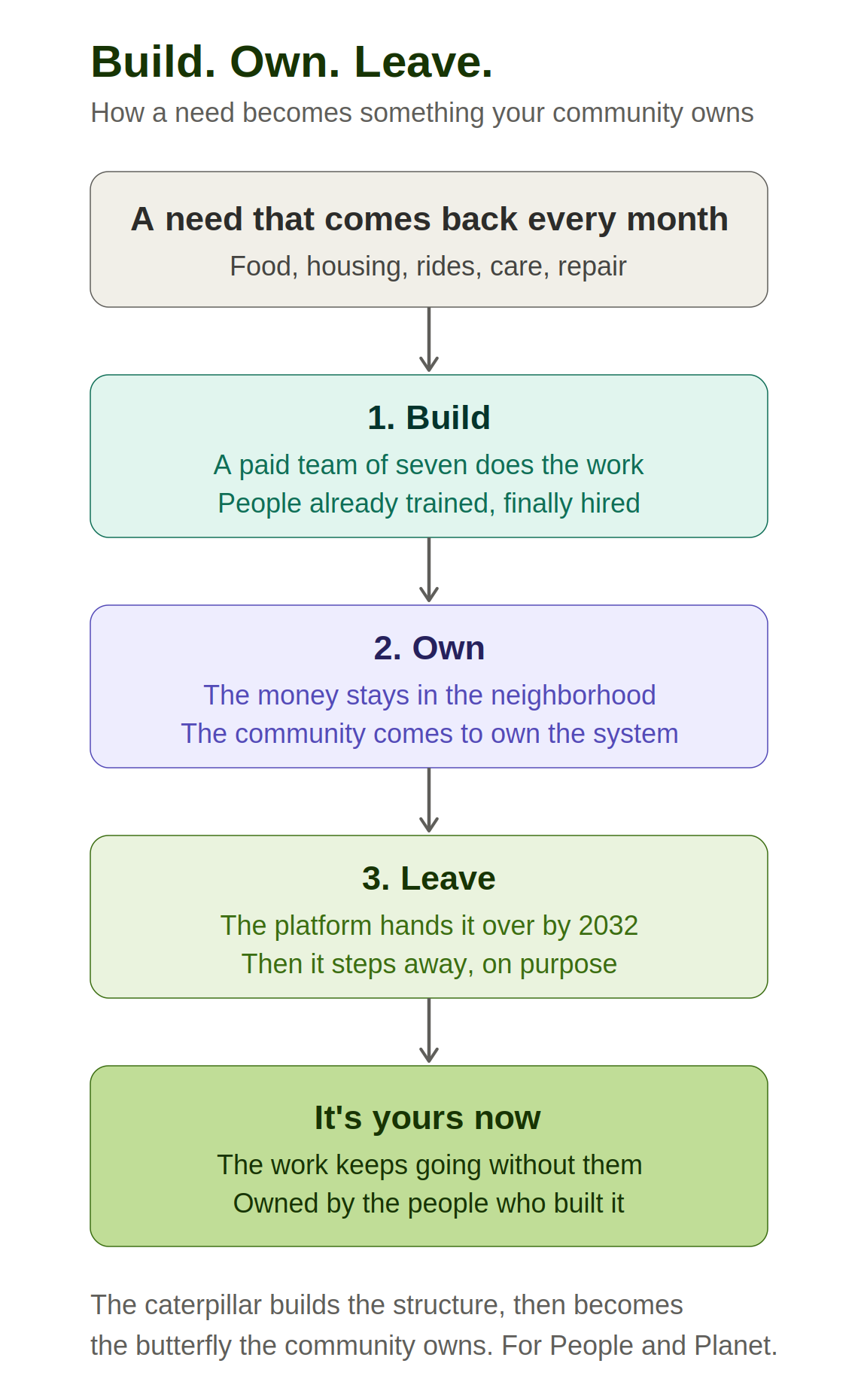
The platform is temporary. The useful work, relationships, assets, skills, and ownership are meant to stay.
WHAT REMAINS 4 You and Those You Love & Care 4?
The first action matters because it helped now. Then look again.
What did people save or earn? What skill became usable? What knowledge was preserved? What tool, relationship, customer, productive asset, or ownership position remains? Can the people involved do more next time without starting over?
The person succeeds. AND something remains.
The business changes. AND something remains.
The institution leaves. AND something remains.
That is the direction of the work!
Start With What Already Exists
The kitchen already exists. The homes are already standing. The drivers are already driving.
People already cook, drive, repair, care, grow, organize, manage, teach, build, deliver, buy, and solve problems. Buildings, kitchens, garages, tools, vehicles, training programs, businesses, relationships, and public resources already exist. Money is already being spent every month on the needs people are trying to solve.
7YOC asks different questions: What is already here? What do people need? What can people contribute? What is missing? Where is the money going now? Who or what could be harmed, excluded, or left unheard?
1. Complete the Community Survey. Name one need or pressure, identify what is already present, and find the missing connection.
2. Choose one achievable action within seven days. Do it safely and lawfully. Record what happened. Repeat what works. Correct or stop what does not.
Not sure what that first action could be? See what people are already doing.
3. Share what happened. If you completed a useful action — whether it succeeded or failed — preserve what you learned so the next person or community does not have to begin from zero.
If the action failed but you learned something that could improve the next attempt, that learning counts.
You do not need all seven people before you begin.
Three Places to Start
Status note: The pillar models below are 7YOC designs unless the site explicitly says otherwise. A target is a target, not a result. Existing organizations named on deeper pages are examples of work already operating elsewhere, not 7YOC operations or endorsements.
Nutrition HUBS
Start with a lawful kitchen that already exists — a school, community center, restaurant in off-hours, congregation, or another permitted space — and connect it to people who need prepared food and people who can safely cook, pack, coordinate, and deliver it.
The operating questions are simple: get food you can use; move it; have somewhere lawful to prepare it; prepare it safely and handle what is left over; get it to people.
The 7YOC target is a $3 prepared meal. That is a target, not a proven result. Food-safety, licensing, insurance, labor, accessibility, privacy, and local legal requirements still apply.
Food is not charity in 7YOC. Food is infrastructure.
Read: Nutrition HUBS · Find the Gap. Build the Hub.
Housing
Start with paid, supervised work on the homes people already live in: repair, weatherization, insulation, small solar, and household growing systems where appropriate. Renters and owners both can benefit because lower energy and repair costs reduce household pressure now.
Connect people who already have training or useful experience to legitimate local work, then remove practical barriers that keep them from participating — transportation, equipment, supervised experience, childcare, eldercare, scheduling, or another missing connection.
One household → one block → a crew → larger Green repair and construction work.
The maintenance lesson is equally simple: systems fail when nobody owns the daily check. Distributed local responsibility is part of the model.
Transportation
Start with drivers who are already driving. Build local ride and delivery capacity that keeps more value with the people doing the work, connect it to repair so one broken vehicle does not end someone’s employment, and use shared rides or van pools where regular routes do not meet the need.
Transportation is not merely a convenience when reaching work, food, care, school, or family depends on it. Repair is part of the same economic system because keeping a vehicle working can keep a household earning.
The same fare. The same ride. The same work. A different destination for the money.
Green Is the Boundary — and the Job Field
Green is not a fourth pillar and it is not a branding layer added after the work is built. Every pillar operates inside an environmental boundary.
Before people build, buy, cook, move, repair, power, package, or dispose of anything, the work asks what happens to children, workers, animals, air, water, soil, habitat, materials, waste, and future generations. Harm is measured, corrected, and replaced where safer systems can be built.
Energy and manufacturing run through all three pillars. Solar, weatherization, repair, reuse, local manufacturing, materials recovery, technical training, and maintenance are how food, housing, and transportation become more resilient and less extractive.
That also makes Green a field of work and ownership. Communities should enter the transition early as builders, operators, suppliers, inventors, asset holders, owners, and governing participants — not arrive later only as customers, tenants, borrowers, or low-wage workers inside systems owned elsewhere.
Repair is one of the fastest doors into that work. Keeping a car, home, appliance, tool, building system, or material in useful service can lower household pressure and create local Green work at the same time.
Water work is still in development. Healing is developed through its own pathway. Read Green Is How We Live for the environmental framework, and Healing Houses for the healing model.
Who Runs the Work
Local neighborhood teams run local work. The women-held governing structure protects the shared platform rules. It does not command a neighborhood or own its assets.
A local Team of 7 is built around seven capabilities rather than seven ranks: coordination; resources and relationships; technical and systems knowledge; research and records; subject-matter and lived expertise; information and technology; and communication.
One person may carry more than one capability. A person may do different work on the next project. People move between teams as the work changes. A formal Team of 7 forms when the responsibilities are real and people have shown that they will return.
A team lead coordinates. A team lead does not command.
One person can begin. The team forms through the work.
Safety, Disagreement, and Correction
Anyone on a team, and anyone directly affected by the work, can stop work that is unsafe or that people did not agree to. The stop holds until the problem is resolved. No one person lifts it alone, including the coordinator.
When a test fails or people cannot agree, do not hide the result or make the project bigger to escape the problem. Preserve what still works. Repair what caused harm or confusion. Check the evidence. Then choose the strongest lawful action the people affected can actually carry together.
Record what failed, what changed, and what the team learned. That knowledge should reach the next person or team so they do not have to repeat the same mistake.
A trustworthy team is not one that always agrees. It is one that can correct itself without punishing honesty.
When Useful Work Becomes an Enterprise
When a need keeps returning and real demand continues, the work may need employment, contracts, insurance, accounting, permits, equipment, facilities, professional support, or capital.
That is when an institutional bridge can help. A foundation or another lawful institution may temporarily carry responsibilities the local group cannot yet carry directly. It does not become the permanent owner of the community’s work. Transfer is built into the structure from the beginning.
Need becomes organized demand → demand becomes useful work → work produces customers, revenue, savings, evidence, skills, and relationships → those support assets → assets and authority move toward accountable community ownership.
Learn → Serve → Earn → Own → Teach.
Read Build, Protect, Keep the Work for the institutional bridge. Read The Community Ramp to see how learning and useful service can grow into paid work, ownership, and knowledge passed to the next person.
Want to watch the whole engine run in one place?
See the Healing House example in The Community Ramp →
Choose One Next Step
You do not need to understand all of Seven Years of Change before you begin. You do not need all seven people. You do not need to start with a large project.
Start with the Community Survey. Name one need, identify one ability or resource already present, and choose one safe action for this week.
Read Build, Protect, Keep the Work. Use it when the work now needs employment, contracts, insurance, administration, resources, or temporary asset stewardship without giving away community ownership.
Read The Community Ramp. Use it to follow the path from learning and service to paid work, ownership, and teaching the next person.
Have something to bring: skill, time, relationships, property, facilities, equipment, professional capacity, capital, or willingness to work? Read Altruism Is Not a Donation. It Is Participation — then Help Build This.
One person can begin. The team forms through the work.
For People and Planet. Until Green Is How We Live.