Healing Houses
Why Seven Years of Change Exists: To Give Us Back the Time to Heal
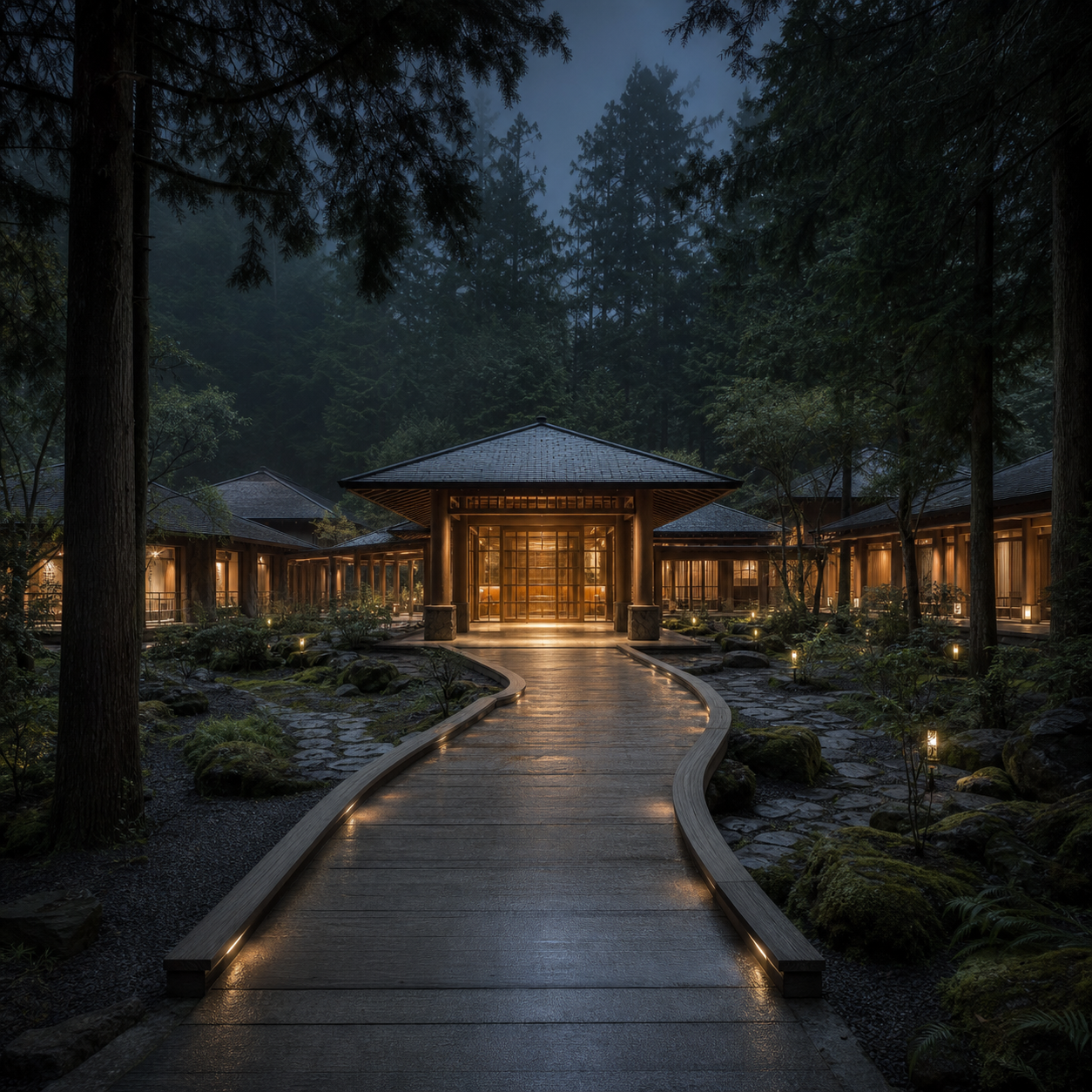
Look at the house for a moment before you read on.
To anyone who uses a wheelchair or moves through the world differently: I should have replaced this image sooner. I recognized that the steps did not reflect the welcome a Healing House must offer, yet I left it here. I am sorry. Every Healing House must meet you at the door. You are counted, always. The image is AI generated.
A woman leaves a loud street in the middle of a busy city. She steps onto a stone path under tall trees. With every step, the horns and sirens and hurry get softer. By the time she reaches the round wooden door, the noise is gone. What is left is birdsong, her own breath, and warm light coming through the windows.
Inside, the floor drops a step, as in some Japanese homes, so the body knows it has arrived somewhere lower, slower, and safe. There is a room for acupuncture. A room for massage. A sauna. Quiet rooms where a person can sit with a counselor, one-on-one. Larger rooms where people gather in circles and finally set down the things they have carried alone for years. Music lives in this house too, because some healing arrives through the ears before it reaches the heart.
This house is not built yet.
But it is not imaginary either.
It grows from work I have already helped build.
The Work We Started
From roughly 2006 to 2009, I helped build the business plan, financial structure, operations, and community relationships for what was then Alternative Healing Network, also known as AltHealNet, in San Diego. That organization is now Community Wellness Collaborative. The public record confirms that Alternative Healing Network officially rebranded as Community Wellness Collaborative in 2021, with a stated belief that access to wellness should be an inherent right.
I worked with the founder of the organization, a gifted acupuncturist, whose acupuncture and healing arts practice helped anchor the clinical side of the model. Community Wellness publicly identifies Dr. Ryan Altman, DACM, L.Ac., as founder and CEO, and credits him with creating the Healing Arts Festival, Integrative Health Nights clinical rotation, and the Adams Avenue Integrative Health facility.
My work was on the operating side: the business plan, financials, community relationships, outreach logic, and the larger question of how this could become a repeatable community model rather than a single beautiful local project.
That matters because the Healing House is not a theory I discovered later. It is part of a vision I have carried for years: healing spaces in every community that chooses to build them, supported by local economies, not left to survive within the same extractive system that makes people sick.
We Learned From Working Class Acupuncture
Working Class Acupuncture deserves direct attribution here.
In developing our early model, we spoke with and learned from Working Class Acupuncture about its approach to community-based care. Their model helped demonstrate that acupuncture need not be priced as a luxury service. It can be delivered in shared rooms, with modest overhead, sliding-scale pricing, and a structure that allows people to come back often enough for the care to matter.
Working Class Acupuncture began in Portland in 2002 as a sliding-scale clinic and describes its purpose as making acupuncture accessible through a low-cost, high-volume, patient-funded model. Its current public materials list regular treatments on a $25 to $45 dollar sliding scale.
That is the lesson 7YOC carries forward: healing must be reachable. A person living with chronic pain, grief, stress, trauma, or exhaustion does not need one symbolic appointment. They need access. They need rhythm. They need care they can return to without having to choose between treatment and groceries.
Working Class Acupuncture also places community acupuncture inside a deeper history. It traces community acupuncture in the United States to the Lincoln Acupuncture Detox Collective in the South Bronx in the 1970s, where community activists pushed for care that met urgent public health needs. The Black Panthers brought acupuncture to Oakland, California around the same time.
That history matters. It reminds us that healing has always been connected to justice.
What the Early Model Proved
Community Wellness Collaborative later reported more than 120,000 low-cost services and more than 35,000 free services for community members in need. It also described a cross-subsidy model: full-priced services helped support free and low-cost care, and its “3 = 1” membership structure connected paid services to care for underserved community members.
That means the model worked.
People came.
Practitioners served.
The community understood the need.
But the larger lesson is just as important: even successful healing work can be vulnerable when it stands alone. Rent rises. Grant funding shifts. Space gets expensive. Staff and practitioners burn out. People who need care still may not have transportation, childcare, food stability, or paid time away from work.
Community Wellness announced the end of clinical operations at its Adams Avenue facility in April 2026 while continuing outreach programs. That closure does not erase the success of the work. It demonstrates why the next version must be protected by a larger community economic structure.
That is where Seven Years of Change comes in.
Trauma Has a Body
This is not only about sore backs and tired muscles.
Trauma has a body. Stress has a body. Grief has a body. Fear has a body. Poverty has a body. Working two jobs has a body. Raising children while broke has a body. Caring for elders while your own body is failing has a body. Racism has a body. War has a body. Eviction threats have a body. Debt has a body.
SAMHSA describes trauma as events or circumstances that can have lasting adverse effects on a person’s functioning and mental, physical, social, emotional, or spiritual well-being.
Many working people are not “fine.” They are functioning.
They are getting through the shift. Getting the children fed. Getting the elder to the appointment. Getting the rent paid late. Getting the groceries on the credit card. Getting through the funeral. Getting through the diagnosis. Getting through the school year. Getting through hard memories. Getting through the layoff. Getting through the silence.
The body keeps the score long after the calendar moves on.
The Healing House exists because people cannot fully lead, build, study, parent, organize, or love when their bodies have never been given a place to release what they survived.
This is not a promise of miracle cures. Acupuncture and other wellness services are offered responsibly by properly trained and licensed practitioners, with respect for safety, consent, and clear standards. NCCIH says acupuncture may be helpful for several pain conditions and notes that licensing requirements vary by state.
7YOC will not sell false hope.
It builds responsible access.
Why 7YOC Makes the Healing House Possible
A Healing House cannot stand alone.
That is the mistake the next generation has to correct.
A clinic can be loving and still be crushed by rent. A practitioner can be gifted and still burn out. A nonprofit can serve thousands and still be forced to close a physical location. A community can need care and still be too tired, too broke, or too far away to receive it.
Seven Years of Change is designed to change the conditions around healing.
Nutrition Hubs reduce food pressure. Housing work creates stability. Transportation systems help people reach care, work, school, and family. Energy and local manufacturing keep resources and skills in the neighborhood. Community foundations, membership shares, donations, grants, capped-return investment, and cooperative ownership help hold the structure underneath the work.
That is the difference.
The Healing House is not an isolated wellness center. It is part of a community economic self-determination platform.
The old model proved people would come.
The old model proved paid services could help fund free services.
The old model proved acupuncture, massage, music, outreach, and community trust could bring healing within reach.
7YOC is how we finish the larger work: not one clinic, not one neighborhood, not one heroic practitioner, not one grant cycle, but a replicable community healing system.
I Have Carried This Into Rooms Before
Want to see the engine actually run?
One building. One operating week. Training, care, food, transportation, paid work, free care, and the Ramp connected with real numbers.
See the Healing House example in The Community Ramp →
In 2006 or 2007, during Obama’s campaign work in San Diego, I introduced Michelle Obama, then the future First Lady, to Dr. Ellen Beck to highlight community health and wellness as issues the country needed to take seriously.
Dr. Beck is publicly recognized for her work with the UC San Diego Student-Run Free Clinic Project, which began in 1997 and grew to multiple county locations offering services that include primary care, specialty care, dental care, pharmacy, vaccines, food, acupuncture, social work, support groups, and mental health services. I believe and am humbled that I can call Dr. Beck a friend.
I include that history because 7YOC is not being built from abstraction.
For years, I have believed that health, food, economics, education, environment, and dignity belong in the same conversation. A person cannot be well inside a system designed to exhaust them. A family cannot heal while every institution around them extracts more time, money, energy, and hope.
The Healing House is one answer.
The House We Build Now
A 7YOC Healing House includes acupuncture, massage, counseling, group circles, sauna, music, movement, rest, and culturally respectful healing practices. It uses licensed practitioners, clear safety standards, consent, privacy, and trauma-informed care.
But the heart of the model is bigger than services.
The heart of the model is this:
Healing should be close enough to reach.
Affordable enough to return to.
Safe enough to trust.
Supported enough to last.
And connected deeply enough to the local economy that it does not disappear the moment rent rises or funding shifts.
This is why 7YOC starts with the solution. Every community needs a house like this. Every community deserves one. And every community that chooses to participate can begin laying the path now.
And to be plain about one thing: this work runs alongside our duties as citizens, including voting. It replaces none of them. We vote, barriers and all, and we build at the same time. Building is how we protect what voting is for. A rested, cared-for community is a community with the strength to keep showing up, at the ballot box and everywhere else.
The forest is real.
The path is real.
The door opens for everyone.
Seven Years of Change.
sevenyearsofchange.org
Sources
Community Wellness Collaborative (formerly Alternative Healing Network / AltHealNet): organization history, 2021 rebrand, leadership, services reported, and the April 2026 close of clinical operations at the Adams Avenue facility.
Working Class Acupuncture: 2002 Portland founding, low-cost high-volume patient-funded model, current sliding-scale pricing, and the history tracing community acupuncture to the Lincoln Acupuncture Detox Collective in the South Bronx.
SAMHSA (Substance Abuse and Mental Health Services Administration): description of trauma and its lasting effects on functioning and well-being.
NCCIH (National Center for Complementary and Integrative Health): guidance on acupuncture for pain conditions and the note that licensing requirements vary by state.
UC San Diego: history of the Student-Run Free Clinic Project and Dr. Ellen Beck’s work.
What now?
If you need help right now — Start Here
If you want to build something where you live — The Work
If you are still deciding whether to believe any of this — Integrity Statement